
Forced-Dues States Suffering From Massive ‘Brain Drain’

Federally-sanctioned forced union dues have predictable economic consequences.
Among them are Big Labor’s use of rigid work rules and cultivation of the “hate the boss” mentality to cement its power over employees.

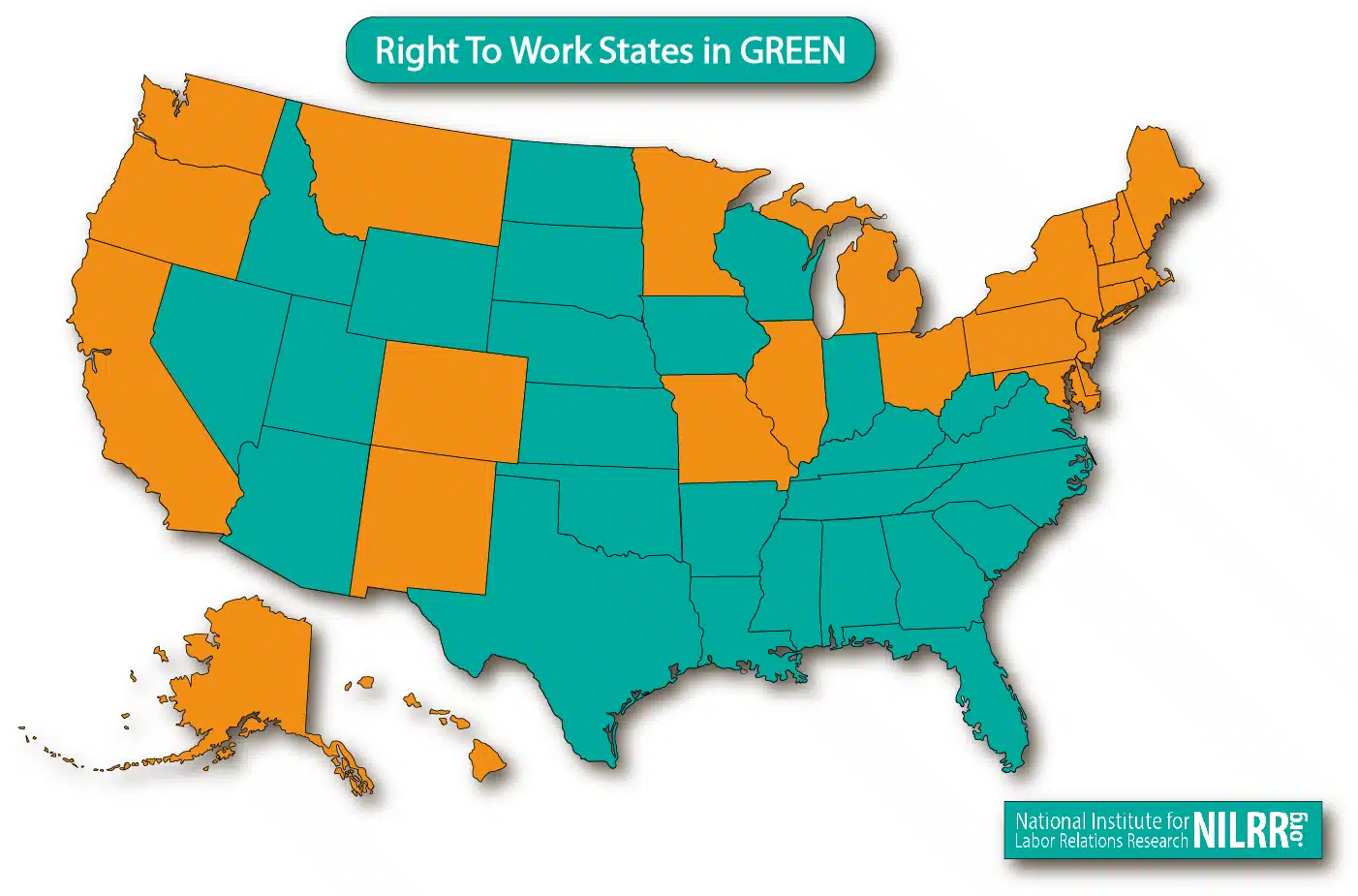
Right to Work laws, now on the books in 22 states, protect the freedom of both private- and public-sector employees to keep and hold a job without forking over dues or fees to a union that is recognized as their “exclusive” (actually, monopoly) bargaining agent.

Unless they are protected by a state Right to Work law, independent-minded employees have no power to fight back against union bosses by withholding their financial support. And when employees have no personal freedom of choice, union bosses have little incentive to tone down their class warfare. Employees are consequently far less likely to reach their full productive potential and reap the accompanying benefits.

That’s a key reason why a wide array of demographic and economic indicators, including young- adult migration, show that forced union dues inhibit growth.

To read the rest of this document, click on the attachment link below.


Two Million K-12 Teachers Are Now Corralled Into Unions

And 1.3 Million Are Forced to Pay Union Dues, as Well as Accept Union Monopoly Bargaining

Education observers of all political stripes recognize that officials of the 3.2 million-member National Education Association and the 1.4 million-member American Federation of Teachers teacher unions, as well as officials of state and local NEA and AFT affiliates, wield enormous clout over how America’s schools are run.

In a paper distributed last year, for example, Dr. Terry M. Moe, a political science professor at Stanford University and a prominent scholar in the field of education policy, concluded, citing his latest and previous research, that NEA and AFT union officers “use their power to shape the structure and ultimately the performance of government [schools].”

Click on the attachment link below to continue reading…


Top 10 Big Labor Lies and Misleading Claims About the Colorado Right to Work Amendment

Union Bosses and Other Compulsory-Unionism Apologists Aren’t ‘Entitled to Their Own Facts’

Now that it appears likely Coloradans will vote this November 4 on a proposed constitutional amendment that would prohibit the firing of employees for refusal to join or pay dues or fees to an unwanted union, union officials and other compulsory-unionism apologists have launched a $25-35 million-dollar campaign (according to their own, undoubtedly low-ball estimate) of lies and distortions to ensure the amendment doesn’t pass.


Michigan Trails Right to Work States In Real, Disposable Per Capita Income

Residents of Every Midwestern Right to Work State Are Better off Than Michiganians

Just a few years ago, Colorado State University business professor Raymond Hogler, one of the most prominent academic opponents of state Right to Work laws in the U.S., acknowledged (in a paper coauthored with economist Robert LaJeunesse): “A number of studies present statistical data substantiating the point that right to work states create and retain more manufacturing jobs.”

The Hogler-LaJeunesse concession regarding factory jobs also applies to private-sector jobs in general. Between 2002 and 2007, for example, private-sector jobs in Right to Work states increased by a net 9.6%. That’s nearly triple the relatively small increase in private-sector jobs experienced by non-Right to Work states over this period.

Non-Right to Work Michigan, where Big Labor wields “exclusive” (monopoly) power to bargain with employers over the wages, benefits, and work rules of a higher share of private-sector employees than in all but one other state in the continental U.S., has an especially dismal employment picture. Along with forced-dues Ohio, which suffered a 0.4% private-sector job decline from 2002-2007, Michigan is one of just two states with negative job growth over the five year period. And Michigan’s decline of 5.2% is far worse than Ohio’s.

To continue reading the rest of the article, click on the attachment below.


Private-Sector Job Growth Faster in Right to Work States

Study Reveals Right to Work States’ Lead in Job Growth Consistent Over Time

The National Institute for Labor Relations Research today released its annual study comparing private-sector job growth in Right to Work states with private-sector job growth in states that do not protect employees from federal policies authorizing the termination of workers for refusal to pay dues or fees to an unwanted union.

The study reveals that not only is private-sector job growth faster in Right to Work states, but also that Right to work States’ lead in job growth is consistent over time.

See study attachment.

For further information, contact the Institute’s Senior Research Associate Stan Greer, 703-321-9606, or stg@nrtw.org.


How Much Is Pro-Forced Unionism Federal Labor Policy Costing America?

With Repeal of Forced Dues in 2000, Annual GDP Could Have Been $436 Billion Higher by 2006

No one can state with certainty the price tag of the federal labor-law provisions that authorize the firing of roughly 7.3 million Americans employees should they refuse to pay union dues or fees as a job condition.

However, data issued last fall by the U.S. Commerce Department’s Bureau of Economic Analysis (BEA) indicate that, had Congress abolished federally-imposed union dues at the turn of the millennium, by 2006 the annual national economic output would have increased by an additional $436 billion in real 2000 dollars.

BEA data show that between 2000 and 2006 the combined real output of states with Right to Work laws barring all forced union dues and fees grew by 3.13% a year. That’s nearly half again as fast as the combined 2.11% real annual output growth of states that do not protect employees from federally-imposed forced union dues. (Oklahoma, which adopted its Right to Work law in September 2001, is excluded from this analysis. See Table I for more information.)

To put it another way, had the entire country grown as fast as the Right to Work states did over just this six-year period, by 2006 our national gross domestic product (GDP) would have been $11.727 trillion in chained 2000 dollars, $436 billion more than the actual figure of $11.291 trillion.


Reality Check For Mike Gronstal on Right to Work, Hawkeye State’s Economy

Iowa’s 2001-2006 Income, Job Growth Greater Than Every Neighboring Forced-Dues State’s

In a recent Q&A session with journalists, including Des Moines Register columnist David Yepsen and AP senior political writer Mike Glover, Iowa state Senate Majority Leader Mike Gronstal (D-Council Bluffs) distorted the facts about the relative performance of Iowa’s economy to justify his ongoing crusade to gut the state’s Right to Work law.


Five Reasons Why Congress Should Enact a National Right to Work Law

  1. Freedom to Associate Also Means Freedom Not to Associate - The average man on the street, as well as constitutional scholars, understands that any genuine personal right should include the freedom to refrain from exercising that right.

  2. Right to Work Bolsters Job Creation, Personal Income Growth - In addition to freeing millions of Americans from the yoke of forced union dues, a national Right to Work law would at the same time help to improve our nation’s economy.

  3. Right to Work’s Benefits Reach Citizens at All Income Levels - In addition to protecting the freedom of association and promoting economic development, Right to Work laws are an anti-poverty program with a proven record of success.

  4. Passage of a National Right to Work Law Would Eliminate All Forced-Dues Politicking by Private-Sector Union Bosses - Not passing a national Right to Work law means not only that American workers will be denied a brighter economic future. It also means that millions of private-sector workers will continue to be forced to contribute to political candidates they do not wish to support.

  5. A National Right to Work Law Would Reduce Union Corruption - The incestuous relationship between forced union dues and corruption was captured perfectly by the late U.S. Sen. John McClellan (D-Ark.): “Compulsory unionism and corruption go hand in hand.” McClellan was referring to the corruption inherent within labor organizations that depend on the forced tribute of workers.


<<Page 2>>
Syndicate content


National Institute for Labor Relations Research
5211 Port Royal Road, Suite 510
Springfield, VA 22151
(703) 321-9606 Fax: (703) 321-7342
research@nilrr.org