
Forced-Unionism Expansion Would Hurt Young Employees the Most

Low Union-Monopoly States Furnish ‘Safety Valve’ For Americans Aged 25-34 Who Can’t Find Decent Job Opportunities in High Union-Monopoly States, Census Bureau Data Show

The newly published 2010 edition of the U.S. Census Bureau’s Statistical Abstract of the United States shows that, in 2008, there were 40.932 million U.S. residents aged 25-34 living in one of the 50 states or Washington, D.C. That represents a 5.6% increase over the total 25-34 year-old population in 1998. In absolute terms, the U.S. population in this age bracket increased by 2.158 million over the past decade.

The overall U.S. population from 1998 to 2008 increased by 12.5%, well over double the growth rate for the young-adult population. The relatively slow growth in the number of 25-34 year-olds is widely recognized as a significant impediment to economic growth because of the group’s high participation in the labor force. Among males aged 25-34, 92.2% had jobs or were seeking them in 2007, compared to just 73.2% of all males 16 and over. Among females in the 25-34 age bracket, 74.5% were labor-force participants, compared to 59.3% of all women 16 and over.

Click on the attachment link below to continue reading this article.


Big Labor’s Bread and Butter

Relentless Growth of Government Payrolls Is Good News For Union Bosses, But Will State and Local Taxpayers Keep Picking up the Tab?

In mid-December, two of America’s best known labor economists, Drs. Barry Hirsch and David Macpherson, released their analysis of Current Population Survey (CPS) data for the first 11 months of 2009, indicating strongly that last year, for the first time ever, a majority of unionized workers across America were government employees.

Today Big Government, not the private sector, is Big Labor’s bread and butter. That’s why union bosses unabashedly push for higher taxes and bigger government, and seem unconcerned that the policies they advocate will surely slash overall private-sector job growth in future years.

And this winter, Congress appears poised to enact legislation that would fuel even faster growth of monopoly unionism in government employment. The so-called “Public Safety Employer-Employee Cooperation Act” (H.R. 413/S. 1611) is detrimental to the interests of private employees and businesses, indeed, of everyone who pays taxes.

Click on the attachment link below to read the rest of this article.


Tax-Paying Families Are Fleeing Forced-Unionism States

Since 2000, a Net Total of 1.63 Million Federal Tax Filers Have Escaped to Right to Work States

Early this year, economist Mark Perry posted a table (which had originally appeared in the National Right to Work Newsletter) on his heavily trafficked Carpe Diem blog showing that the eight states enjoying the greatest net in-migration of people from other states between 2000-2008 all have Right to Work laws. The table also showed that, of the eight states suffering the worst out-migration, only Katrina-ravaged Louisiana has such a law.

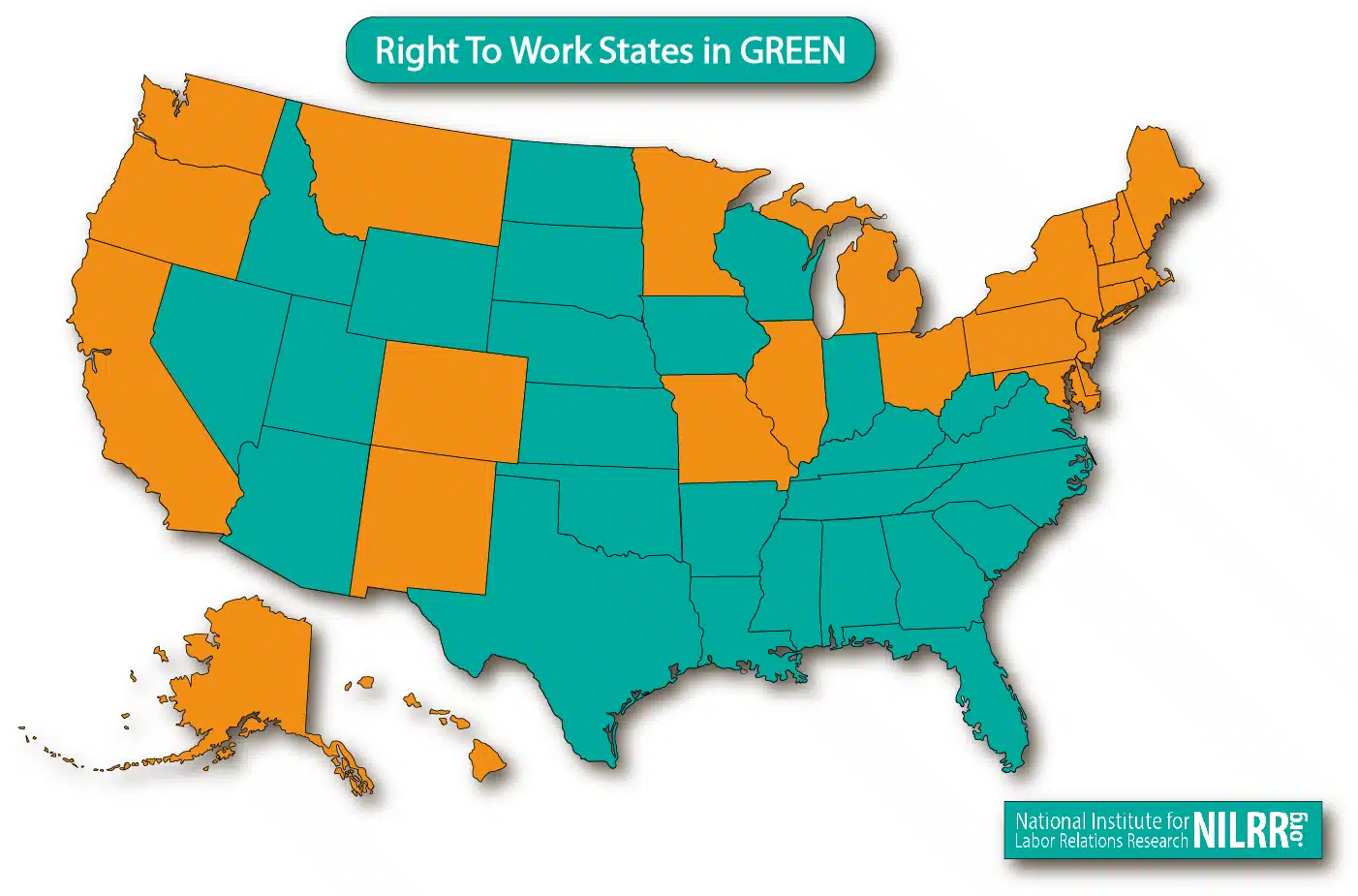
Right to Work laws protect employees from federal policies authorizing the termination of workers for refusal to pay dues or fees to an unwanted union. To most Carpe Diem readers, the table undoubtedly furnished compelling evidence that the 22 Right to Work states as a group offer a far better climate for jobs and businesses than do the 28 states that do not protect employees from forced unionism.

However, additional data collected by the federal government make the case for Right to Work’s economic benefits even more compelling.

Specifically, the IRS tracks and makes available data that enable researchers to calculate how much income, on average, personal income tax filers who move to a Right to Work state take in the first year after they move.

To continue reading this document, click on the attachment link below.


Negative Employment Growth Since November 2001

High-Unionization States Are Suffering a ‘Lost Decade,’ But, Even With Recent Setbacks, Low-Unionization States Have Gained Nearly 1.5 Million Private-Sector Jobs Since Last Recession

Early this month, BusinessWeek Economics Editor Michael Mandel bemoaned the fact that U.S. private-sector employment is currently lower than it was in the trough of the last nationwide recession. Citing preliminary August 2009 data for the nation as a whole, Dr. Mandel wrote:

[W]e are down 839K private jobs compared to the previous trough in November 2001. The only other negative trough-trough case was July 1980 to November 1982 – and many economists treat the 1980 and 1981-82 recessions as a single downturn.

Dr. Mandel and the numerous other economic pundits and economists who have since cited his September 4 blog post on “America’s lost decade for jobs” are calling attention to an important trend, but not the one that the media savvy Harvard-trained economist seems to think he is describing.

A closer look at the data cited by Dr. Mandel shows that, although he treats the U.S. as a monolith, just 22 of the 50 states actually have negative private-sector job growth since November 2001. Furthermore, a review of the state-by-state job data alongside state private-sector unionization data suggests that pro-monopoly labor policy, a factor not mentioned at all by Dr. Mandel, may be the principal reason why the job market has been so bad in nearly half the states.

U.S. public policy generally opposes monopolies, or at the very least purports to do so. But federal labor law and the labor laws of most states actually encourage union monopoly control over employees. This fact sheet focuses on federal labor law, which targets the overwhelming majority of private-sector employees and businesses across the country.

To continue reading this article, please click on the attachment link below.


Union Monopoly Linked to Lower Purchasing Power

Cost of Living-Adjusted Earnings and Disposable Incomes Are Highest in Least-Unionized States

United States Senate Majority Leader Harry Reid (D-Nev.) is expected, as soon as next month, to bring to the Senate floor legislation designed to help Organized Labor increase, sharply and across the country, the share of private-sector employees who are compelled to accept a union as their “exclusive” bargaining agent in their dealings with their employer.

To continue reading, please click on the attachment link below.


Governors’ Bi-Partisan Message to Congress: Don’t Federalize Public-Safety Union Monopoly

State Executives’ Successful 2009 Vetoes of Big Labor Power Grabs Under Attack in U.S. Capitol

Two years ago this month, the U.S. House of Representatives rubber-stamped Congressman Dale Kildee’s (D-Mich.) cynically mislabeled “Public Safety Employer-Employee Cooperation Act.” This Big Labor-backed legislation would have established a new federal mandate imposing “exclusive representation,” i.e. monopoly bargaining, over state and local police and firefighters and other public-safety employees nationwide. However, intense public opposition, mobilized primarily by the National Right to Work Committee, prevented the Kildee bill from passing the Senate during the 2007-2008 Congress.

It has long been a goal of government union officials to wield broad monopoly-bargaining power over state and local employees across the nation. Mr. Kildee’s bill, which he has reintroduced in the current Congress as H.R. 413, would be a first step towards achieving this objective.

Hundreds of thousands of firemen, policemen and paramedics who up to now have been free under state law to negotiate on their own behalf would be stripped of that freedom by H.R. 413. It may accurately be labeled as the “Police/Fire Monopoly-Bargaining Bill.” And, if the experience of states that have enacted similar public-sector monopoly-bargaining laws is any indication, H.R. 413 would lead to substantially heavier burdens for taxpayers.

To continue reading, click on the attachment link below.


‘Card-Check’ Forced Unionism Threatens Job-Based Private Health Insurance

In Least-Unionized States, Ranks of Insured Have Increased by Nearly Three Million Since 1999

Critics of the major government-run health-care proposals now being hammered out by congressional Democrats and the Obama Administration charge they would destroy private employers’ ability to furnish employees with health insurance at a manageable cost. Ultimately, critics charge, the proposals being discussed would leave employees and their families with no alternative to a government-run insurance policy.

It is outside the expertise of the National Institute for Labor Relations Research to assess the validity of these charges.

However, anyone with a knowledge of the rankings of the 50 states according to the share of private-sector employees who are under “exclusive” union representation, and multi-year U.S. Census Bureau data regarding the number of insured people in each state, can see that another leading legislative objective of congressional Democrats and the White House definitely does threaten job-based private health insurance nationwide.

This legislative goal is enactment either of the cynically mislabeled “Employee Free Choice Act” (S. 560 and H.R. 1409), or of Trojan Horse “compromise” legislation that would, through different means, also help Organized Labor secure monopoly-bargaining power over millions of additional workers and hundreds of thousands of now-independent small businesses.

S. 560 and H.R. 1409 were introduced in Congress March 10, respectively by Big Labor Sens. Ted Kennedy (D-Mass.) and Tom Harkin (D-Iowa) and by Congressman George Miller (D-Calif.). In addition to making it far easier for union officials to obtain “exclusive” (monopoly) bargaining control over employees, this legislation would, in non-Right to Work states, also make it far easier for Big Labor to browbeat employers into consenting to fire employees who refuse to join or pay dues or fees to a union.

The Kennedy/Harkin/Miller scheme’s best-known provision would rewrite federal law concerning “card checks.” Under current law, union bosses are already able to acquire monopoly power to negotiate employees’ pay, benefits, and work rules solely through the collection of signed “union authorization cards.” Consequently, individual workers under the peering eyes of union organizers may be intimidated into signing not just themselves, but all of their nonunion fellow employees, over to union-boss control.

However, as stacked as current law is in favor of Big Labor’s forced-unionism power, employers nevertheless retain the right to stand up for their independent employees against union-boss intimidation tactics. But S. 560 and H.R. 1409 would empower union officials to impose forced unionism through card check automatically, with no recourse for any pro-Right to Work employee or employer.

Click on the attachment link below to read the entire document.


Will Big Labor Congress Prime the Pump For More State and Local Tax Hikes?

Federally Mandated Union Monopoly Over Public-Safety Employees Dangerous For Taxpayers

Union-label Speaker Nancy Pelosi (D-Calif.) is expected soon to bring to the U.S. House floor legislation that would federally mandate union monopoly bargaining over state and local public-safety employees across the country. H.R. 413, the Police/Fire Monopoly-Bargaining Bill, was introduced in January by Congressman Dale Kildee (D-Mich.). Mr. Kildee’s cynically misleading label for the measure is the Public Safety Employer-Employee Cooperation Act of 2009.

H.R. 413 would rewrite the public-sector labor laws of the vast majority of the 50 states to make them more supportive of so-called “exclusive” union bargaining in the public sector.

In states that don’t currently authorize public-safety monopoly bargaining, H.R. 413 would impose it, denying localities the option to refuse to grant a single union the power to speak for all front-line employees, including those who don’t want to join. And in most states that already authorize public-safety union monopoly bargaining, H.R. 413 would widen its scope.

For example, under current Massachusetts law, state police and other state government union officials wield monopoly power to negotiate employees’ pay with state agencies, but do not have any control over employees’ health insurance plans. But H.R. 413 would force Massachusetts legislators either to rewrite state law to grant government union officials monopoly-bargaining power over the health plans of all public-safety workers employed at the state level, or allow federal bureaucrats to do the same thing for them.

To continue reading, click on the attachment link below.


Right to Work’s Wide Job-Growth Advantage Cuts Across Regions

Western, Southern and Midwestern States Rank in Top Eight For 2003-2008 Employment Gains

For many years, U.S. Labor Department data have shown that states with Right to Work laws on the books have far faster private-sector job growth than states that do not protect employees from federal policies authorizing the termination of workers for refusal to pay dues or fees to an unwanted union. The latest available data show Right to Work states retain a wide job-growth advantage.

Between 2003 and 2008, private-sector jobs in the 22 Right to Work states increased by an aggregate 9.1%. That’s 2.5 times as great as the relatively small increase in private-sector jobs experienced by the 28 non-Right to Work states over this period. (See the tables on pages three and four for details.)

The correlation between a state’s Right to Work status and job growth is extraordinarily strong. Among the eight states with the biggest gains in private-sector employment over the past five years, seven – Wyoming, Utah, Nevada, Idaho, Arizona, Texas and North Dakota – have Right to Work laws. These states are located in the West, the South, and the Midwest. Montana was the only non-Right to Work state to rank among the top eight – and its job gains were outpaced by all five of the Right to Work states in the West, where Montana is located.

Meanwhile, seven states had private-sector job growth of less than two percent or negative job growth over the past five years. All seven – Indiana, Maine, Michigan, New Jersey, Ohio, Rhode Island and Vermont – are forced-dues states.

To continue reading this fact sheet, please click on the attachment link below.


2 3 4
Page 1>>
Syndicate content


National Institute for Labor Relations Research
5211 Port Royal Road, Suite 510
Springfield, VA 22151
(703) 321-9606 Fax: (703) 321-7342
research@nilrr.org