
'Card-Check' Forced-Unionism Bill Would Hurt Employees and Employers
For years, scientific opinion polls have shown that Americans overwhelmingly oppose federal labor laws that empower union officials to represent all employees in a company unit and deny union nonmembers the right to bargain for themselves. But Organized Labor’s top priority in the 2007-2008 Congress, the inaptly named “Employee Free Choice Act,” would rewrite federal labor law to make it even easier for union officials to secure monopoly-bargaining privileges over employees.
Well aware that the American people oppose monopoly unionism, union officials are citing their legislation’s allegedly beneficial economic effects as the key reason for passing it. However, even a cursory look at the contrasting economic track records of states in which a relatively high share of employees are under union monopoly bargaining and states in which monopoly bargaining is relatively rare shows this case is phony.
The record shows that the prevalence of union monopoly bargaining is correlated with lower real incomes, higher living costs, slower growth in jobs and job benefits, and higher unemployment. The evidence is overwhelming that enactment of federal legislation that is designed to put millions of additional workers under union monopoly-bargaining control would be economically harmful, not beneficial.
If Congress really wants to bolster the U.S. economy and help employees and businesses, it should instead revise federal labor law to ensure that it respects the ability of each individual employee to choose whether or not to be represented by and furnish financial support for a labor union.
How Monopolistic Teacher Unionism Is Undercutting Math and Science Education
Executive Summary
Most mainstream media reporting on the supply and demand for K- 12 public schoolteachers across America ignores the dramatic differences for teachers at different grade levels and in different fields. Around the country, school officials typically report they have no trouble at all finding qualified people to teach in grades K-5 and middle and high school subjects like physical education, social studies, and English. However, school officials in every region of the U.S. frequently find it difficult if not impossible to recruit and retain qualified math, science, and special education teachers.
There are two reasons for the substantial and growing shortage of qualified teachers in fields like math and science. First, teachers and prospective teachers with this specialized knowledge can nearly always command much higher salaries in the private sector than they can in teaching. This is not nearly so true of other teachers. Second, the so-called “single salary schedule” used to determine teacher pay rates in the vast majority of school districts in the country does not allow school officials to offer higher pay for hard-to-fill teaching positions.
School officials who routinely fail to fill math and science teaching positions, or fill them only with teachers who actually specialize in other fields, would undoubtedly modify or scrap the single salary schedule, but for the entrenched opposition of teacher union officials, especially local and state officers of the National Education Association.
And teacher union officials have so far been very successful in
blocking significant reforms of the single salary schedule because
of state and local public policies authorizing them to act as the
“exclusive” (monopoly) bargaining agents of all the K-12 teachers
in a school district.
Big Labor: A $20 Billion-a-Year Business
More Than Seven Million Private-Sector Workers Forced to Pay Dues or Fees, or Be Fired!
All private-sector and a substantial minority of public-sector American unions are required each year to file LM-2 or LM-3 financial disclosure forms with the U.S. Department of Labor. An analysis of the most recent LM-2 and LM-3 forms filed by all unions that are required to do so shows their aggregate annual receipts come to $20.1 billion.
Why Are Workers Still Dangling in the ‘Blue Eagle’s’ Talons?
Today, relatively few Americans remember that in 1933 Congress enacted legislation obliging businesses to form committees with their competitors to write “codes” prescribing the “rules of fair competition” for their industry. Businesses that refused to report how much they charged customers or charged less than was mandated by a code could be subjected to fines of up to $500 per “offense,” with each day considered a separate offense.
The 1933 law, known as the National Recovery Act (NRA), was overturned by the U.S. Supreme Court two years later. But heavy-handed federal attempts to prevent “excessive” or “cutthroat” competition among American businesses continued for decades.
Freedom of Choice, Business Climates, and Right to Work Laws
The ideals of an open society require the protection of freedom of
choice in personal, political and economic relationships. Federal
policies that force employees to pay dues or fees to a union as a
condition of employment directly restrict the individual employee’s
economic freedom. And their effective scope is actually much
wider.
Misdirection and Misrepresentation: Big Labor’s Campaign Against an Indiana Right to Work Law
A recent paper by Jeff Vincent, research director of the Division of
Labor Studies at Indiana University, grossly misrepresents the facts
about Right to Work laws and the economic and moral arguments
that have been made in support of enacting such a law in Indiana.
The Economic Benefits of a Michigan Right to Work Law
It’s hard to put a positive spin on Michigan’s economic track record in recent years, or on the state’s prospects for the future assuming no significant change in current policies.
Between 1994 and 2004, Michigan ranked dead last among the 50 states in nonfarm employment growth. The average state enjoyed a percentage job gain more than two-and-a-half times as great as Michigan’s.1
Just in the past three years, the Wolverine State has lost 40,000 young people in
the job market due to out-migration to other states, according to David Littmann, senior
economist for the Midland, Mich.-based Mackinac Center for Public Policy.
The Case of the Missing Young Employees
Recently released U.S. Census Bureau data show that, as of 2003, more than two
million young people aged 25 to 34 were missing in the 28 states that do not have Right
to Work laws barring the exaction of compulsory union dues and fees as a condition of
employment.
Project Labor Agreements: Union Monopoly in Public Works Construction
Project labor agreements, or
PLAs, have been around since the 1930s. But they have become an increasingly common
means for unions to exercise, directly or indirectly, monopoly power over labor markets
since the U.S. Supreme Court gave them the green light in 1993 – in a ruling involving
another massive Boston project. Less than 15% of America’s private-sector hardhat
labor force currently belongs to a union, but PLAs ensure that many of the most lucrative
projects are effectively union-only.
The Standard of Living in Right to Work States
Barry W. Poulson, Ph.D.
Professor of Economics
University of Colorado, Boulder
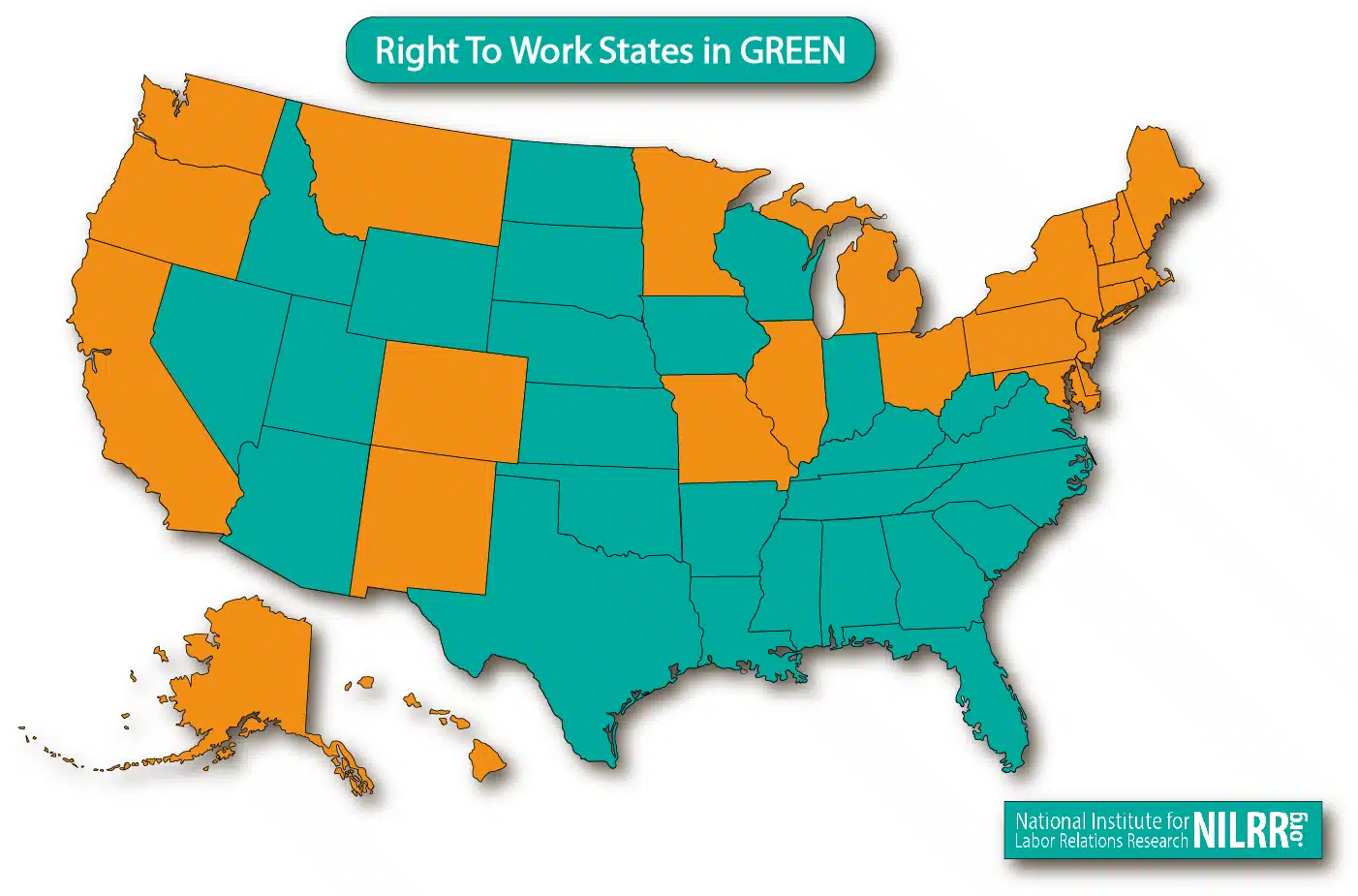
Twenty-two states now have Right to Work laws. In these states employees do not have
to financially support a union with monopoly bargaining privileges at their work place in
order to keep their jobs. In states that do not have Right to Work laws, an employee of a
unionized firm must financially support the union in order to get or keep his or her job.
Individual employees in these states are coerced into paying union dues, regardless of
whether they desire union representation. Union officials often defend this coercion on
5211 Port Royal Road, Suite 510
Springfield, VA 22151
(703) 321-9606 Fax: (703) 321-7342
research@nilrr.org