
‘Compulsory Unionism in Everything But Name . . .’

More than 11 years ago, union operatives submitted an internal report to the AFL-CIO Executive Council that assessed how Big Labor might destroy existing state Right to Work laws and stymie the National Right to Work Committee’s increasingly effective efforts to pass new laws. [..]


Why Are Workers Still Dangling in the ‘Blue Eagle’s’ Talons?

Today, relatively few Americans remember that in 1933 Congress enacted legislation obliging businesses to form committees with their competitors to write “codes” prescribing the “rules of fair competition” for their industry. Businesses that refused to report how much they charged customers or charged less than was mandated by a code could be subjected to fines of up to $500 per “offense,” with each day considered a separate offense.

The 1933 law, known as the National Recovery Act (NRA), was overturned by the U.S. Supreme Court two years later. But heavy-handed federal attempts to prevent “excessive” or “cutthroat” competition among American businesses continued for decades.


Case For an Ohio Right to Work Law is Both Moral and Economic

‘Freedom to Associate of Necessity Means as Well Freedom Not to Associate’

Constitutional scholars and the man in the street alike understand that any genuine personal right must include the freedom to refrain from exercising that right. That’s why the First Amendment guarantee of freedom of the press doesn’t just bar Congress from forbidding a newspaper to publish a particular opinion. It also bars Congress from ordering a newspaper to publish that opinion.

The Supreme Court of Maine succinctly stated this fundamental principle in its 1955 Pappas v. Stacey decision: “Freedom to associate of necessity means as well freedom not to associate.” But federal labor law, like many state laws that are modeled after it, doesn’t protect employees’ freedom in the commonly accepted sense of the word. It recognizes the right to join a union. At the same time, however, it authorizes and promotes the firing of employees for refusal to join or pay dues to a union that is certified by government bureaucrats as their “exclusive” (actually, monopoly) bargaining agent.

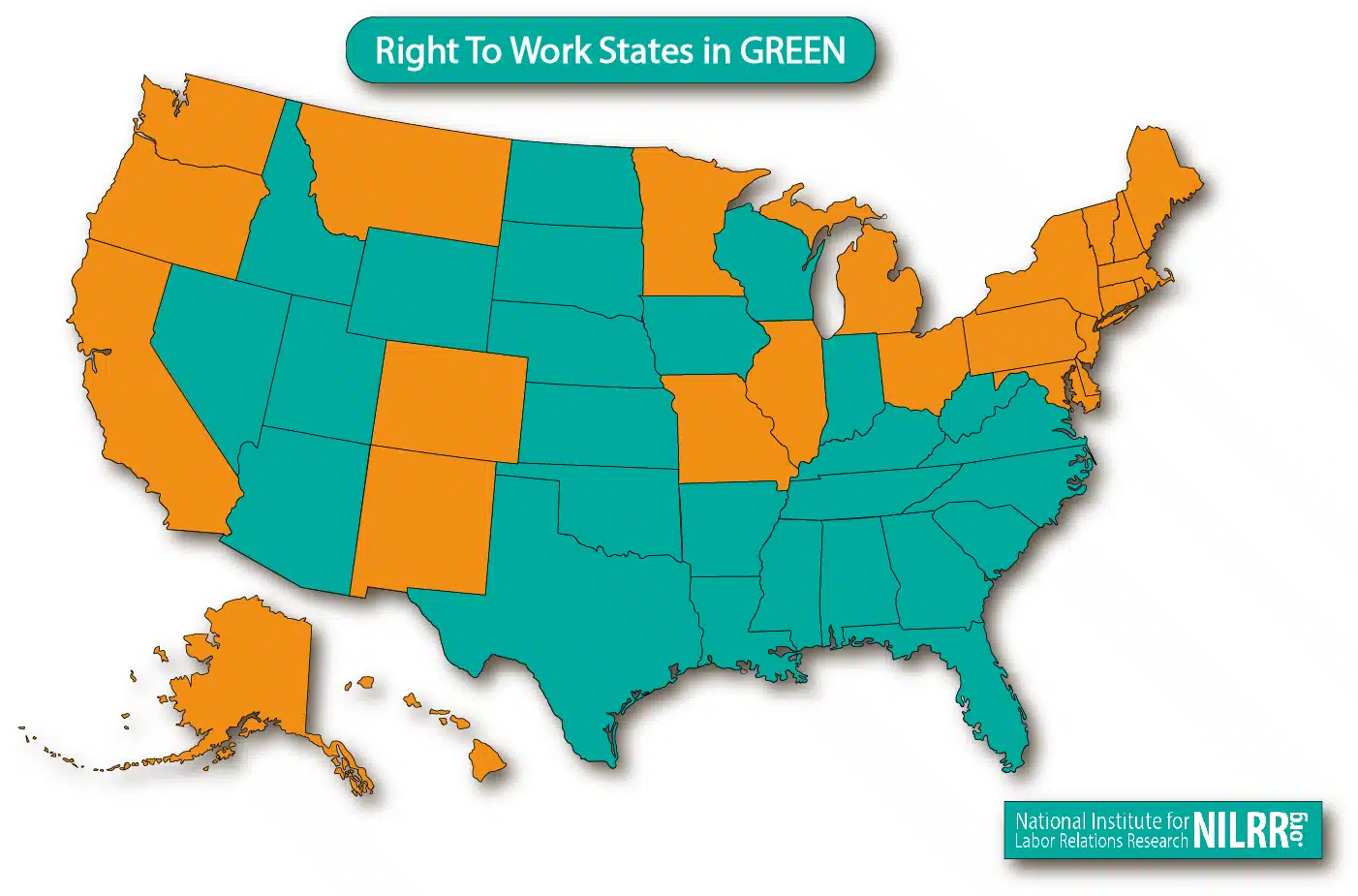
Twenty-two states have laws that apply the right-to-refrain principle to labor-management relations. These laws, known as Right to Work laws, bar the firing of employees for favoring a union or for refusing to join or pay dues to a union. If a worker’s freedom to affiliate with a union merits government protection (and the overwhelming consensus is that it does), then the freedom not to affiliate with a union must be equally protected.

An Ohio Right to Work law would deter the exploitation of employees as a means to anyone’s end by protecting employees from both employers and union officials who would deny them freedom of association.

There is overwhelming evidence that Right to Work laws are economically beneficial. Here’s how David Littmann, the former senior vice president and chief economist for the Detroit-based Comerica Bank and current senior economist for the Mackinac Center for Public Policy, summed up the evidence this February in testimony before the Michigan House Tax Committee on Restructuring: “Economic growth in right-to-work states has so convincingly and consistently eclipsed the average growth for non-right-to-work states that it makes the whole argument for workplace flexibility a non-controversial subject.”

Between 1995 and 2005, U.S. Department of Labor data show private-sector job growth in Right to Work states exceeded private-sector job growth in non-Right to Work states as a group by 79% and in Ohio alone by nearly 500%. Over the same period, inflation-adjusted U.S. Commerce Department data show real personal income growth in Right to Work states exceeded overall personal income growth in non-Right to Work states by 39% and exceeded Ohio’s meager increase by 142%. Meanwhile, U.S. Census Bureau statistics show that, from 1994 to 2004, the number of citizens covered by private health insurance grew by 11.5% in Right to Work states, slightly more than double the aggregate growth in non-Right to Work states. In Ohio, over the same period, the ranks of the privately insured actually declined by 0.2%.

State Right to Work laws have a long track record of helping below-average economies turn into economic leaders. The experiences of the two states that most recently enacted Right to Work laws, Idaho and Oklahoma, are good examples.

In the decade before its Right to Work law first took effect in 1986, Idaho’s employment growth was barely more than half the national average, according to the U.S. Labor Department. But over the past two decades, Right to Work Idaho repeatedly topped the nation in job creation. Between 1995 and 2005, private-sector jobs in Idaho increased by a net 30.3%, more than double the nationwide figure and nearly ninefold Ohio’s paltry job growth.

Oklahoma’s economic performance was also sub-par before its Right to Work law was approved in 2001. In the decade leading up to the law’s enactment, real personal income growth in the Sooner State was six percent below the national average. However, since the state Supreme Court unanimously rejected two Big Labor lawsuits designed to overturn the Right to Work law in December 2003, thus reassuring businesses and individuals it would remain on the books, Oklahoma’s economic picture has gotten brighter and brighter.

From the first quarter of 2005 through the first quarter of 2006, real personal income in Oklahoma grew by 2.9% — roughly double the national average and nearly three times as fast as the overall average of the 28 forced-dues states. According to the U.S. Commerce Department, personal income in the Sooner State is now growing faster than in every single forced-dues state. A wide array of businesses have recently made or announced major new investments in Oklahoma.

For example, this June, Mercury MerCruiser, a manufacturer of stern-drive marine engines, broke ground on a 23,000-square-foot expansion of its die-casting operations in Stillwater, Okla. The $13.5 million expansion is adding new jobs for machinists and die-cast operators. And in July, the newly formed MG Motors announced it was reviving the famous British MG brand, with headquarters in Oklahoma City. Assembly and distribution will be located in Ardmore, and research and development will be in Norman at the University of Oklahoma. MG Motors will create hundreds of jobs with a payroll in excess of $30 million.

Federally-sanctioned forced union dues have predictable economic consequences. Among them are Big Labor’s use of rigid work rules and cultivation of the “hate the boss” mentality to cement its power over employees. Right to Work laws protect the freedom of both private- and public-sector employees to keep and hold a job without forking over dues or fees to a union that is recognized as their monopoly- bargaining agent.

Unless they are protected by a state Right to Work law, independent-minded employees have no power to fight back against greedy and tyrannical union bosses by withholding their financial support. And when employees have no personal freedom of choice, union bosses have little incentive to tone down their class warfare. Employees are consequently far less likely to reach their full productive potential and reap the accompanying benefits.

That’s a key reason why almost every economic and demographic indicator shows that forced union dues inhibit growth, and why Wachovia Vice President and Senior Economist Mark Vitner told Site Selection magazine in 2004 that Right to Work laws are “vitally important” for economic development.

Legislators in economically lagging Ohio will be gravely remiss if they do not, in the near future, consider enactment of state Right to Work legislation, which will protect the individual employee’s freedom and, history indicates, bring major economic benefits.

# # #

Nothing here is to be construed as an attempt to aid or hinder the passage of any bill before any legislative body.


Right to Work States: Magnets For Young Employees

Just since 2000, an estimated net total of 637,000 young Americans who are now 21-30 years old have relocated from a state in which employees may be fired for refusal to join or pay dues or fees to an unwanted union to a state with a Right to Work law that prohibits such unjust firings.


Right to Work Laws Improve Access to Pensions

Forced Unionism Reduces Employers’ Ability to Furnish Pension Coverage

Forced-unionism apologists often concede that job growth, both overall and private-sector in particular, is far more brisk in Right to Work states than in non-Right to Work states. But after making such concessions, they invariably claim that the jobs created in Right to Work states aren’t good jobs with good benefits.

However, data compiled by the Washington, D.C.-based Economic Policy Institute (EPI) in a long-term, ongoing study of the trends in private-sector pension access in the 50 states debunk one of


Compulsory Unionism in Education

One of the greatest things about America is that we are free to elect our own government representatives. Anyone who is considered an adult and a United States citizen is allowed to vote for the people who will make the laws of the land.

Abraham Lincoln once said, “No man is good enough to govern another man without that other’s consent.” (1) Freedom of choice is the basis of our Constitution.

The first Amendment to the U.S. Constitution outlines certain basic rights which all citizens enjoy. One of these is the freedom of association. This amendment includes our right to join or unite with others for a variety of reasons, such as clubs or labor unions.


Right to Work States’ Job-Growth Advantage Widens

For many years, U.S. Labor Department data have shown that states with Right to Work laws on the books have far faster private-sector job growth than states that do not protect employees from federal policies authorizing the termination of workers for refusal to pay dues or fees to an unwanted union.


Freedom of Choice, Business Climates, and Right to Work Laws

The ideals of an open society require the protection of freedom of choice in personal, political and economic relationships. Federal policies that force employees to pay dues or fees to a union as a condition of employment directly restrict the individual employee’s economic freedom. And their effective scope is actually much wider.


Misdirection and Misrepresentation: Big Labor’s Campaign Against an Indiana Right to Work Law

A recent paper by Jeff Vincent, research director of the Division of Labor Studies at Indiana University, grossly misrepresents the facts about Right to Work laws and the economic and moral arguments that have been made in support of enacting such a law in Indiana.


1 2 3
5 6 7
<<Page 4>>
Syndicate content


National Institute for Labor Relations Research
5211 Port Royal Road, Suite 510
Springfield, VA 22151
(703) 321-9606 Fax: (703) 321-7342
research@nilrr.org