
National Institute for Labor Relations Research Recent Posts



U.S. Labor Policy Fails Working Americans
By force of "Law," Americans can lose: personal agency, freedom of association, their jobs unless they bend the knee, free speech rights, their property rights, rights to due process, and can be compelled to support political causes ... learn more.
FEATURED: Big Labor’s Rise to Power, or Big Labor Never Lets a Tragedy Go to Waste
FEATURED POST: Big Labor’s Rise to Power, or Big Labor Never Lets a Tragedy Go to Waste - a brief labor policy history.
NILRR Research: The National Labor Relations Act (NLRA, 1935), Norris-LaGuardia Act, and related laws created compulsory unionism, forced dues, monopoly bargaining, and the NLRB—granting union bosses powers that ordinary Americans and businesses do not have.
These arguably extra-constitutional privileges have fueled violence (including violent and deadly acts that have been shielded by the Enmons Decision under the Hobbs Act) and must end.
Multiple federal laws and court rulings grant union bosses immunity from antitrust laws, injunctions, extortion prosecutions, and more—while stripping workers of their First Amendment rights to free speech, freedom of association, and their Fifth Amendment property rights. Right to Work laws (via Taft-Hartley Section 14(b)) are a proven partial reform, but a nationwide reset to equal rights and justice under the law is needed.
For example, Exemption from Prosecution for Union Violence — The U.S. v. Enmons (1973) Supreme Court ruling shields union officials from Hobbs Act extortion charges for threats, vandalism, and assaults during labor disputes if they are for so-called “legitimate” union goals. Thousands of violent and deadly incidents have gone unpunished.
Learn More: Union Bosses’ Privileges & Super Constitutional Powers
Welcome to the National Institute for Labor Relations Research
The National Institute for Labor Relations Research (NILRR) provides comprehensive information and research concerning labor relations and policies. Located at NILRR.org, the institute analyzes labor relations, particularly highlighting the implications of compulsory unionism and promoting Right to Work principles.
It provides educational resources for the public, scholars, and students by offering data, research, and fact sheets on labor issues. NILRR aims to inform about the benefits of Right to Work laws, which allow workers to choose whether or not to join or financially support a union without fear of losing their jobs.
$100 Available for Students and Recent Grads

Notable Quotes
The following quotes are labor union officials' actual comments.
"When school children start paying union dues, that's when I'll start representing the interests of school children."
"So, you tell me how I can possibly separate NEA’s collective bargaining efforts from politics—you just can’t. It’s all politics.”
"We (NEA) want a legislative program led by leaders and staff with sufficient clout that they may roam the halls of Congress and collect votes to reorder the priorities of the United States of America."
"We are the biggest potential striking force in this country, and we are determined to control the direction of education.”
Another example of why you need and deserve Right To Work laws...

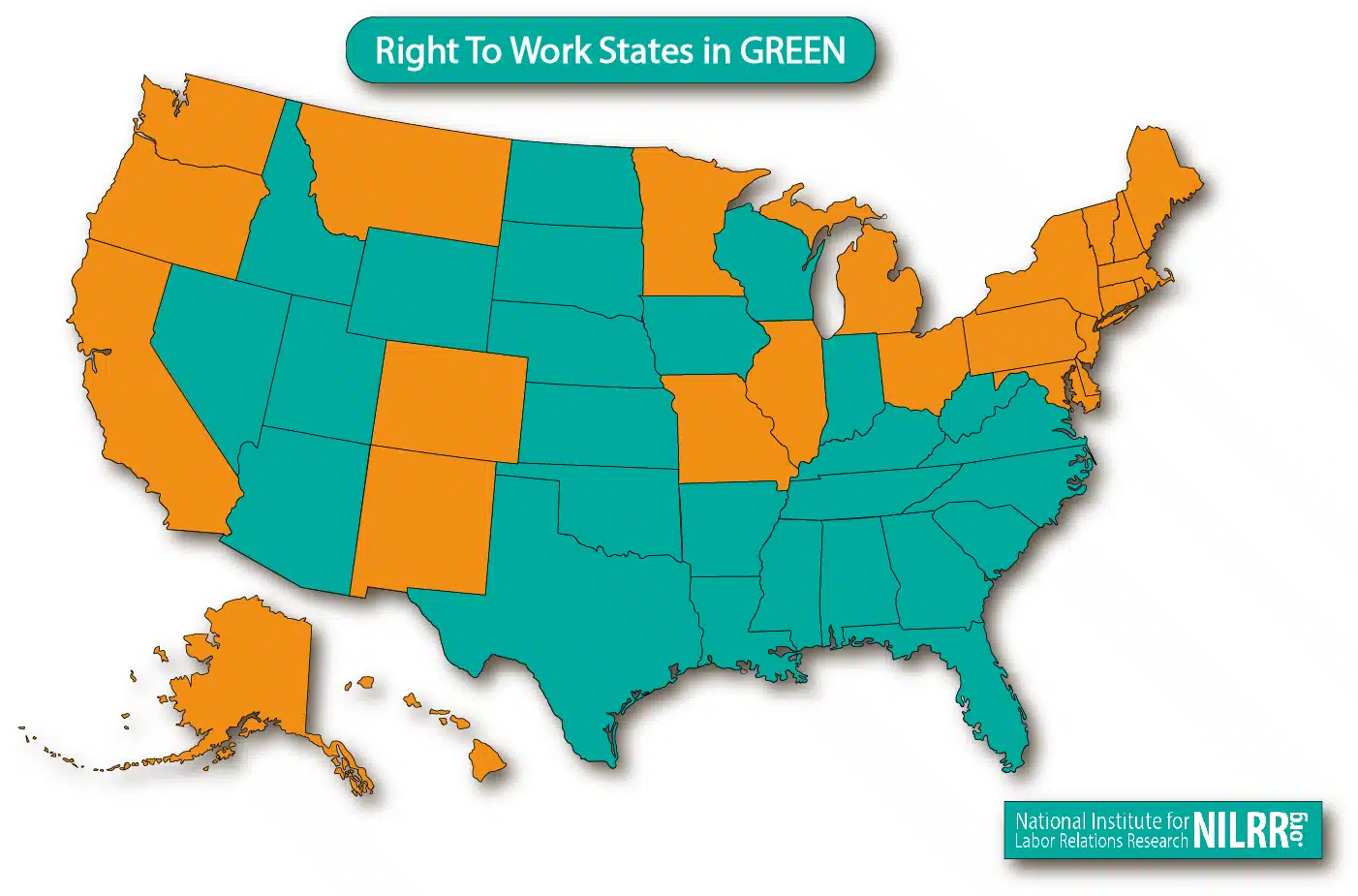
Which states are Right To Work States?
The following states are the current Right to Work States listed in alphabetical order:
Alabama, Arkansas, Arizona, Georgia, Idaho, Indiana, Iowa, Kansas, Kentucky, Louisiana, Mississippi, Nebraska, Nevada, North Carolina, North Dakota, Oklahoma, South Carolina, South Dakota, Tennessee, Texas, Utah, Virginia, West Virginia, Wisconsin, and Wyoming.