
Five Reasons Why Congress Should Enact a National Right to Work Law

  1. Freedom to Associate Also Means Freedom Not to Associate - The average man on the street, as well as constitutional scholars, understands that any genuine personal right should include the freedom to refrain from exercising that right.

  2. Right to Work Bolsters Job Creation, Personal Income Growth - In addition to freeing millions of Americans from the yoke of forced union dues, a national Right to Work law would at the same time help to improve our nation’s economy.

  3. Right to Work’s Benefits Reach Citizens at All Income Levels - In addition to protecting the freedom of association and promoting economic development, Right to Work laws are an anti-poverty program with a proven record of success.

  4. Passage of a National Right to Work Law Would Eliminate All Forced-Dues Politicking by Private-Sector Union Bosses - Not passing a national Right to Work law means not only that American workers will be denied a brighter economic future. It also means that millions of private-sector workers will continue to be forced to contribute to political candidates they do not wish to support.

  5. A National Right to Work Law Would Reduce Union Corruption - The incestuous relationship between forced union dues and corruption was captured perfectly by the late U.S. Sen. John McClellan (D-Ark.): “Compulsory unionism and corruption go hand in hand.” McClellan was referring to the corruption inherent within labor organizations that depend on the forced tribute of workers.


No Truce in IAFF War Against ‘Two-Hatters’

Will Congress Hand Big Labor More Power to Punish Professional Firemen Who Also Volunteer?


Big Labor: A $20 Billion-a-Year Business

More Than Seven Million Private-Sector Workers Forced to Pay Dues or Fees, or Be Fired!

All private-sector and a substantial minority of public-sector American unions are required each year to file LM-2 or LM-3 financial disclosure forms with the U.S. Department of Labor. An analysis of the most recent LM-2 and LM-3 forms filed by all unions that are required to do so shows their aggregate annual receipts come to $20.1 billion.


New Law to Have Major Impact on Employee-Employer Relations in Utah’s Public Schools

Subsection (4) Precludes Monopoly Bargaining, Favoritism, and/or Endorsement of a Union as a Future Option

The National Institute for Labor Relations Research (NILRR) sent out letters to Utah Public and Private School Superintendents, informing them of the impact of a recently-passed Utah legislation affecting employee-employer relations within the state. See sample letter attached.

For further information on the subject, or a copy of the book Stranglehold, mentioned in the letter, see contact information below.

Contact:

  • Stan Greer, senior research associate, 703-321-9606
  • Linda Staulcup, research associate, 703-770-2203

Right to Work Law is Helping Oklahoma Turn Into an Economic Leader

Sooner State No Longer Exporting Young Employees and Entrepreneurs to Other States

On September 25, 2001, a Right to Work Amendment to the Oklahoma Constitution was adopted. Oklahoma is the 22nd and, at this writing, the latest state to enact a Right to Work law. Oklahoma’s Right to Work law, which bars the extraction of forced union dues and fees from workers as a condition of employment, was the product of years of concentrated effort by thousands of citizens.

When Oklahoma Right to Work legislation was introduced back in 1993, it was supported by just 34 of 101 state representatives and 12 of 48 state senators. Because of Big Labor’s huge clout in Oklahoma City, the forced-unionism status quo seemed to be unassailable. The tide turned only because, from the 1994 through the 2000 elections, 28 pro-forced unionism legislators who had refused to change their positions were replaced by Right to Work supporters.

Almost immediately after the Sooner Right to Work law was adopted, union bosses, who had up to then been shrilly predicting that such a law would swiftly lead to disaster, moved to prevent the law from having any impact at all. When the Right to Work law had been in effect just seven weeks, Big Labor lawyers launched an underhanded bid to overturn it. This legal attack kept the Right to Work law’s future under a cloud for more than two years.


Since 2001, Right to Work States Lead in Job Growth, Five-to-One

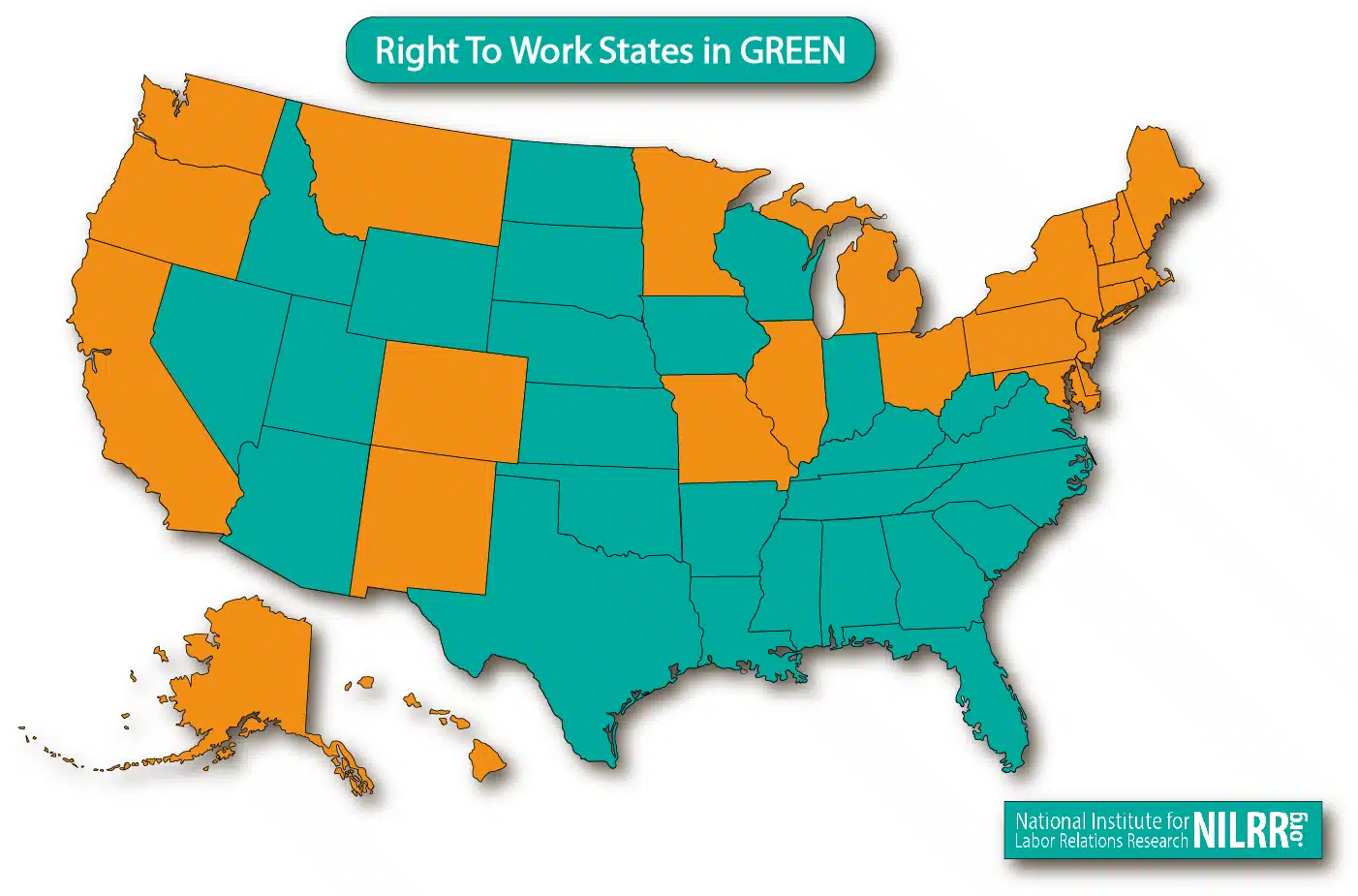
For many years, U.S. Labor Department data have shown that states with Right to Work laws on the books have far faster private-sector job growth than states that do not protect employees from federal policies authorizing the termination of workers for refusal to pay dues or fees to an unwanted union.

Between 1996 and 2006, private-sector jobs in Right to Work states increased by a net 19.8%. That’s an 87% greater increase than the relatively small increase in private-sector jobs experienced by non-Right to Work states over this period. (See the tables on pages three and four for details. Oklahoma, which adopted its Right to Work law in 2001, is excluded from this calculation. However, between 2003, when the Sooner Supreme Court rejected two Big Labor lawsuits designed to overturn the Right to Work law, and 2006, Oklahoma job growth was 6.1%, well over half again as fast as in non-Right to Work states.)

The Right to Work job-growth advantage becomes even more critical in times when the national economy is recovering from a recession.

Over the five years from 2001 to 2006, private-sector jobs in forced-dues states barely increased at all. Over this entire period, private-sector employment went from 68.41 million to 69.25 million, a gain of just 1.2%. Meanwhile, private-sector jobs in Right to Work states increased by 2.6 million, or 6.3%, between 2001 and 2006. (Since Oklahoma was a Right to Work state for the entire period, this time it is included.)


In North Dakota "Opportunity Knocks"

North Dakota has a unique opportunity to demonstrate to the rest of the country what can be accomplished by switching from an exclusive-union-bargaining system in public education to a system in which there is room for individual bargaining.

In a letter (see attached), mailed out last week to School Superintendents throughout the state, National Institute for Labor Relations Research (NILRR) Senior Research Associate Stan Greer laid out what could be a historic opportunity presented by the North Dakota Supreme Court’s unanimous decision in Kenmare Education Association v. Kenmare Public School District No. 28, 2006 ND 136.


Public-Sector Forced Union Fees Would Hurt Iowa’s Private Sector

‘Tax Freedom Day’ Comes 10 Days Earlier in States That Bar All Forced Union Fees

Iowans most recently celebrated “Tax Freedom Day” on April 18, 2006. For Americans as a group, last year Tax Freedom Day came eight days later than in Iowa, on April 26.

The term Tax Freedom Day was coined and popularized by the nonpartisan, Washington, D.C.-based Tax Foundation. As a 2006 Tax Foundation press release explained, it is “the day when Americans … finally have earned enough money to pay off their total [federal, state and local] tax burden for the year.”

Monitoring when Tax Freedom Day falls is an easy way to gauge the American citizen’s heavy tax burden, which on average comprises nearly a third of his or her income. However, residents of different states often have tax burdens that are significantly less or more onerous than the national average.


Why 'Card-Check' Forced Unionism Is Economically Harmful

For years, scientific opinion polls have shown that Americans overwhelmingly oppose federal labor laws that endow union officials with the power of so-called “exclusive” representation over all employees in a company unit, wherein union nonmembers are denied any right to bargain for themselves. But Organized Labor’s top priority in the 2007-2008 Congress, the inaptly named “Employee Free Choice” Act, would rewrite federal labor law to make it even easier for union officials to secure monopoly-bargaining privileges over employees.

Well aware that the American people oppose monopoly unionism, union officials are citing their legislation’s allegedly beneficial economic effects as the key reason for passing it. However, even a cursory look at the contrasting economic track records of states in which a relatively high share of employees are under union monopoly bargaining and states in which monopoly bargaining is relatively rare shows this case is phony.


1 2 3
<<Page 4>>


National Institute for Labor Relations Research
5211 Port Royal Road, Suite 510
Springfield, VA 22151
(703) 321-9606 Fax: (703) 321-7342
research@nilrr.org