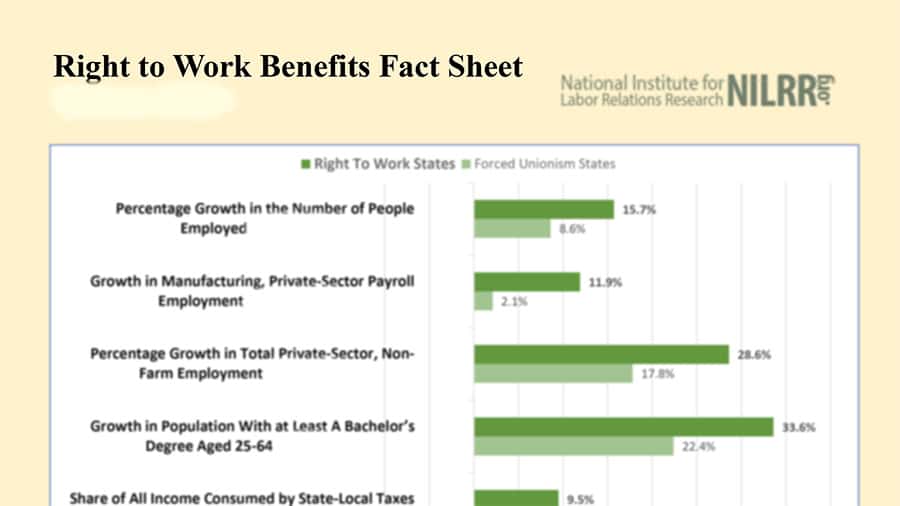
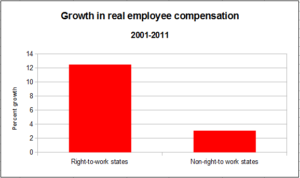
Over the past two decades, the National Institute for Labor Relations Research (NILRR) has documented the harm inflicted on workers and society by compulsory unionism. Studies published by NILRR have shown that legal sanctions for forced-union dues are correlated with lower real average earnings, below-average growth in the number of people with employment-based health benefits, higher real poverty rates, and higher taxes. And NILRR’s ever-growing library of Right to Work-related material offers a unique resource for scholars in the field of labor-management relations. But to sustain its educational program and to maintain and update its library, NILRR needs help from the public to support its mission.
 

Michigan Trails Right to Work States In Real, Disposable Per Capita Income

Residents of Every Midwestern Right to Work State Are Better off Than Michiganians

Just a few years ago, Colorado State University business professor Raymond Hogler, one of the most prominent academic opponents of state Right to Work laws in the U.S., acknowledged (in a paper coauthored with economist Robert LaJeunesse): “A number of studies present statistical data substantiating the point that right to work states create and retain more manufacturing jobs.”

The Hogler-LaJeunesse concession regarding factory jobs also applies to private-sector jobs in general. Between 2002 and 2007, for example, private-sector jobs in Right to Work states increased by a net 9.6%. That’s nearly triple the relatively small increase in private-sector jobs experienced by non-Right to Work states over this period.

Non-Right to Work Michigan, where Big Labor wields “exclusive” (monopoly) power to bargain with employers over the wages, benefits, and work rules of a higher share of private-sector employees than in all but one other state in the continental U.S., has an especially dismal employment picture. Along with forced-dues Ohio, which suffered a 0.4% private-sector job decline from 2002-2007, Michigan is one of just two states with negative job growth over the five year period. And Michigan’s decline of 5.2% is far worse than Ohio’s.

To continue reading the rest of the article, click on the attachment below.

Are you interested in just how Big Labor is spending your forced-dues dollars?

Unions covered by the Labor Management Reporting and Disclosure Act (LMRDA), the Civil Service Retirement Act (CSRA), or the Foreign Service Act (FSA), with total annual receipts of $250,000 or more, are currently required to submit annual financial statements to the US Department of Labor. These statements provide basic information.

The LM-2 Form: This form will tell you when the next union election is, how many members the union has, the salaries of officers and staff, and other useful information, including:

  • Whether the union has any subsidiary organizations
  • Whether the union has a political action committee (PAC)
  • Whether the union discovered any loss or shortage of funds
  • Number of members
  • Rates of dues and fees
  • 7 asset categories such as cash and investments
  • 4 liability categories such as accounts payable and mortgages payable
  • 16 receipts categories such as dues and interest
  • 18 disbursement categories such as payments to officers and repayment of loans obtained
  • A schedule of payments to officers
  • A schedule of payments to employees
  • A schedule of office and administrative expenses
  • A schedule of loans payable.

LM-2 forms (as well as LM-3 and T-1 forms for smaller unions) are public documents that are now online on the website of the US Department of Labor. Note: the forms are searchable. This means you can look for all officers earning over $100,000, for example, or for information about a particular officer or employee of the union. You can also get information on union Trusts and Political Action Committees (PACs).

To search forms available in DOL’s Online Public Disclosure Room or to learn more on how to use the site, click here.

To search LM-2s specifically:

  1. In the “Union Reports and Collective Bargaining Agreements: Online Public Disclosure Room,” scroll down about a third of the window to the first point “Union (Form LM-2, LM-3, or LM-4) Search” under “Access Union Reports and Constitutions and Bylaws.” Click on the highlighted link.

  2. Or, go directly here. Most individuals will not know the file number so just give whatever information you do know. Identify whether you want information about a union, a trust, or both.

    For purposes of this example, select “union,” then choose the union’s Abbreviation (CWA for example), or enter the union’s Affiliation (for example “Communications Workers AFL-CIO”), Organization Name (“Communications Workers of America), Designation Name (whether it is a local, council, conference, etc.), Designation Number (the local or council number, for example, local “1101”), Unit Name (name of that particular unit), City (“New York”) and State (“New York”). You do not need to fill in all the fields to search.

    Most of the form blanks have drop down menus to help you find the official name.

  3. When you have put in the information, hit “submit.” The search engine will open a new page with the unions and reports that match your search.

  4. Select the file you want to see and the type of report you are looking for. If you want to see salary information for officers and employees, select “Reports Specific to LM-2, LM-3, and T-1s; Officer/Employee Report.”

  5. Note: You may have to look at various reports to find the information you want. Also, be sure to check all the pages of a form, not just the page that comes up on your screen. (Look for the “Records Next” button on the upper right.) You can also download the information.

Private-Sector Job Growth Faster in Right to Work States

Study Reveals Right to Work States’ Lead in Job Growth Consistent Over Time

The National Institute for Labor Relations Research today released its annual study comparing private-sector job growth in Right to Work states with private-sector job growth in states that do not protect employees from federal policies authorizing the termination of workers for refusal to pay dues or fees to an unwanted union.

The study reveals that not only is private-sector job growth faster in Right to Work states, but also that Right to work States’ lead in job growth is consistent over time.

See study attachment.

For further information, contact the Institute’s Senior Research Associate Stan Greer, 703-321-9606, or stg@nrtw.org.

How Much Is Pro-Forced Unionism Federal Labor Policy Costing America?

With Repeal of Forced Dues in 2000, Annual GDP Could Have Been $436 Billion Higher by 2006

No one can state with certainty the price tag of the federal labor-law provisions that authorize the firing of roughly 7.3 million Americans employees should they refuse to pay union dues or fees as a job condition.

However, data issued last fall by the U.S. Commerce Department’s Bureau of Economic Analysis (BEA) indicate that, had Congress abolished federally-imposed union dues at the turn of the millennium, by 2006 the annual national economic output would have increased by an additional $436 billion in real 2000 dollars.

BEA data show that between 2000 and 2006 the combined real output of states with Right to Work laws barring all forced union dues and fees grew by 3.13% a year. That’s nearly half again as fast as the combined 2.11% real annual output growth of states that do not protect employees from federally-imposed forced union dues. (Oklahoma, which adopted its Right to Work law in September 2001, is excluded from this analysis. See Table I for more information.)

To put it another way, had the entire country grown as fast as the Right to Work states did over just this six-year period, by 2006 our national gross domestic product (GDP) would have been $11.727 trillion in chained 2000 dollars, $436 billion more than the actual figure of $11.291 trillion.

'Card-Check' Forced-Unionism Bill Would Hurt Employees and Employers

For years, scientific opinion polls have shown that Americans overwhelmingly oppose federal labor laws that empower union officials to represent all employees in a company unit and deny union nonmembers the right to bargain for themselves. But Organized Labor’s top priority in the 2007-2008 Congress, the inaptly named “Employee Free Choice Act,” would rewrite federal labor law to make it even easier for union officials to secure monopoly-bargaining privileges over employees.

Well aware that the American people oppose monopoly unionism, union officials are citing their legislation’s allegedly beneficial economic effects as the key reason for passing it. However, even a cursory look at the contrasting economic track records of states in which a relatively high share of employees are under union monopoly bargaining and states in which monopoly bargaining is relatively rare shows this case is phony.

The record shows that the prevalence of union monopoly bargaining is correlated with lower real incomes, higher living costs, slower growth in jobs and job benefits, and higher unemployment. The evidence is overwhelming that enactment of federal legislation that is designed to put millions of additional workers under union monopoly-bargaining control would be economically harmful, not beneficial.

If Congress really wants to bolster the U.S. economy and help employees and businesses, it should instead revise federal labor law to ensure that it respects the ability of each individual employee to choose whether or not to be represented by and furnish financial support for a labor union.

Reality Check For Mike Gronstal on Right to Work, Hawkeye State’s Economy

Iowa’s 2001-2006 Income, Job Growth Greater Than Every Neighboring Forced-Dues State’s

In a recent Q&A session with journalists, including Des Moines Register columnist David Yepsen and AP senior political writer Mike Glover, Iowa state Senate Majority Leader Mike Gronstal (D-Council Bluffs) distorted the facts about the relative performance of Iowa’s economy to justify his ongoing crusade to gut the state’s Right to Work law.

How Monopolistic Teacher Unionism Is Undercutting Math and Science Education

Executive Summary

Most mainstream media reporting on the supply and demand for K- 12 public schoolteachers across America ignores the dramatic differences for teachers at different grade levels and in different fields. Around the country, school officials typically report they have no trouble at all finding qualified people to teach in grades K-5 and middle and high school subjects like physical education, social studies, and English. However, school officials in every region of the U.S. frequently find it difficult if not impossible to recruit and retain qualified math, science, and special education teachers.

There are two reasons for the substantial and growing shortage of qualified teachers in fields like math and science. First, teachers and prospective teachers with this specialized knowledge can nearly always command much higher salaries in the private sector than they can in teaching. This is not nearly so true of other teachers. Second, the so-called “single salary schedule” used to determine teacher pay rates in the vast majority of school districts in the country does not allow school officials to offer higher pay for hard-to-fill teaching positions.

School officials who routinely fail to fill math and science teaching positions, or fill them only with teachers who actually specialize in other fields, would undoubtedly modify or scrap the single salary schedule, but for the entrenched opposition of teacher union officials, especially local and state officers of the National Education Association.

And teacher union officials have so far been very successful in blocking significant reforms of the single salary schedule because of state and local public policies authorizing them to act as the “exclusive” (monopoly) bargaining agents of all the K-12 teachers in a school district.

Five Reasons Why Congress Should Enact a National Right to Work Law

  1. Freedom to Associate Also Means Freedom Not to Associate - The average man on the street, as well as constitutional scholars, understands that any genuine personal right should include the freedom to refrain from exercising that right.

  2. Right to Work Bolsters Job Creation, Personal Income Growth - In addition to freeing millions of Americans from the yoke of forced union dues, a national Right to Work law would at the same time help to improve our nation’s economy.

  3. Right to Work’s Benefits Reach Citizens at All Income Levels - In addition to protecting the freedom of association and promoting economic development, Right to Work laws are an anti-poverty program with a proven record of success.

  4. Passage of a National Right to Work Law Would Eliminate All Forced-Dues Politicking by Private-Sector Union Bosses - Not passing a national Right to Work law means not only that American workers will be denied a brighter economic future. It also means that millions of private-sector workers will continue to be forced to contribute to political candidates they do not wish to support.

  5. A National Right to Work Law Would Reduce Union Corruption - The incestuous relationship between forced union dues and corruption was captured perfectly by the late U.S. Sen. John McClellan (D-Ark.): “Compulsory unionism and corruption go hand in hand.” McClellan was referring to the corruption inherent within labor organizations that depend on the forced tribute of workers.

No Truce in IAFF War Against ‘Two-Hatters’

Will Congress Hand Big Labor More Power to Punish Professional Firemen Who Also Volunteer?

2 3 4
Page 1>>


National Institute for Labor Relations Research
5211 Port Royal Road, Suite 510
Springfield, VA 22151
(703) 321-9606 Fax: (703) 321-7342
research@nilrr.org